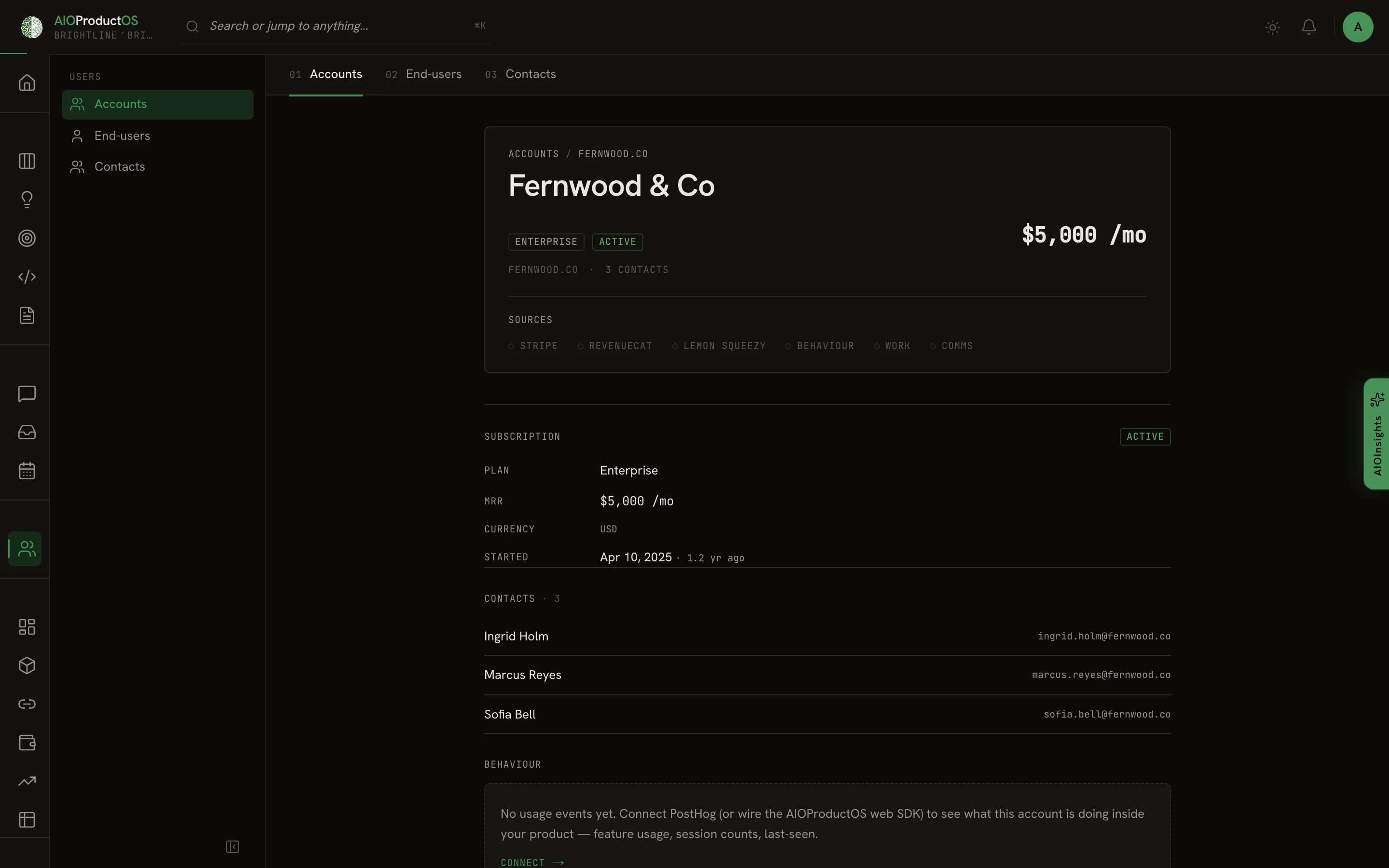
If you are evaluating Segment as a product team, the honest answer is that you may be reaching for a routing tool to solve a joining problem. Segment is a customer data platform: its core job is to collect events and fan them out to destinations. A product spine with built-in connectors does the opposite — it lands 100+ sources on one record so revenue, usage, feedback, and shipped work join directly, with no downstream analytics tool needed to see the result.
What is Segment actually built to do?
Segment’s model is collect-and-route. You instrument your app once, Segment captures the event stream, and it forwards that stream to destinations you configure — analytics tools, ad platforms, email systems, a warehouse. That fan-out is genuinely valuable when you run a wide marketing and growth stack and want one instrumentation layer feeding all of it.
But routing is not joining. Segment gets the same events to many tools; it does not, by itself, make your Stripe revenue queryable next to your Zendesk tickets and your shipped features on one record. Each destination still holds its own slice behind its own schema. The join is still your problem — usually a warehouse-and-SQL problem downstream. If you’re mid-evaluation and want the shortlist rather than the argument, our roundup of Segment alternatives is the shortlist version of this page.
How does a product spine compare?
A spine inverts the goal. The point is not to distribute events; it is to make external data connectable on arrival.
| Segment (CDP) | Product spine + connectors | |
|---|---|---|
| Core job | Collect events, route to destinations | Land sources on one joined record |
| Data ends up | In each destination you configure | On a shared spine, keyed to shared IDs |
| ”Who pays for this feature?” | Query downstream, after modeling | Answered on the spine directly |
| Sources | SDK events + some cloud sources | 100+ connectors (117, 18 categories) |
| Marketing fan-out | Extensive (hundreds of destinations) | Not the goal |
| Governance / consent routing | Deep | Basic |
| Instrumentation | 7 drop-in SDKs, 1.7–5.2 KB | Same footprint class |
The spine ships its own lightweight capture too, 7 drop-in SDKs between 1.7 and 5.2 KB, so you are not giving up event collection to get the join. And the connectors land on the shared spine keyed to the same customers your usage already uses, which is exactly the mechanism a CDP leaves to you. See how the joined model powers analytics and the full source list on the connectors page.
When does Segment win?
When fan-out is the requirement. If your central problem is getting one clean event stream into thirty tools — ad platforms, lifecycle email, attribution, a warehouse, and a long tail of marketing destinations, plus consent management and CDP-grade governance across all of it — that is precisely what Segment is engineered for. A product spine is not trying to be a hundred-destination router, and pretending otherwise would be dishonest.
The dividing line is your end goal. If the answer lives in distributing data to many tools, Segment wins. If the answer lives in joining data on one record, in revenue-weighted funnels and who-actually-pays and did-what-we-shipped-work, the spine wins because the join already exists and you are not paying a warehouse to reconstruct it.
The cost angle
The two approaches also price differently. Segment is one line in a stack that still needs analytics tools, a warehouse, and the engineering time to model the join — the fully loaded number we broke down in the real cost of a product tool stack. A product spine folds capture, connectors, and analysis into one bill: Start $199/month, Team $399, Business $899, 30-day money-back, no free tier. The comparison that matters is not license vs license; it is one joined system vs a routed stack you still have to stitch.
You can judge the join for yourself without signing up. Open the no-signup demo and follow one customer across feedback, revenue, and shipped work on a single record.