Every guide on page one treats roadmap communication as an event. Prepare the deck, tailor it per audience, open with strategy, close with themes, and make sure nobody is surprised in the room. All of it is reasonable. All of it stops the moment the meeting ends.
But the presentation is the easy part. What decides whether stakeholders trust your roadmap is what happens in the eleven weeks between presentations — and what you do on the day something you promised stops being true.
How do you communicate a product roadmap to stakeholders?
Keep one roadmap and generate each audience’s view from it, so tailoring is a filter rather than four documents that drift apart. Run a light rhythm between reviews so nothing in the room is news. And when something slips or gets cut, tell whoever made a promise on it first.
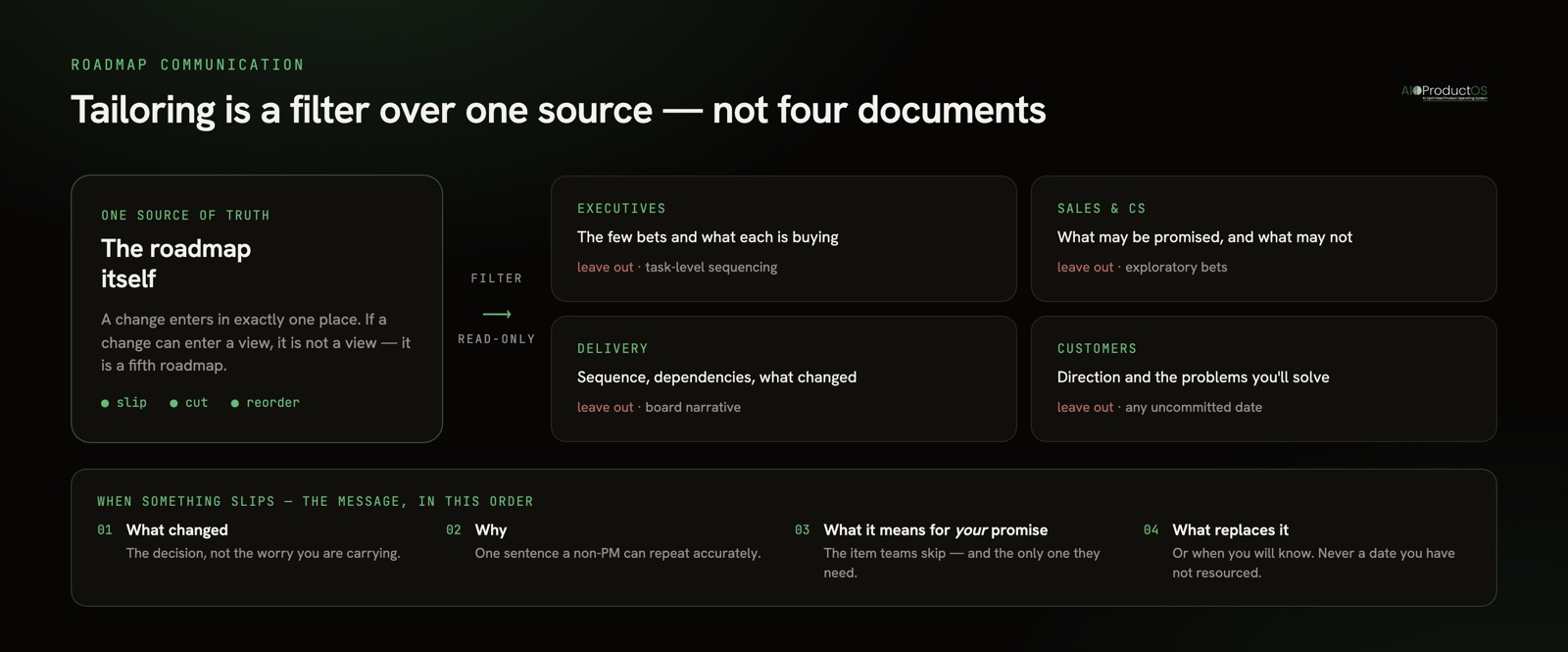
Three claims. The first two are cheap to say and expensive to maintain. The third is the one nobody writes down.
Tailoring per audience is a filter, not four documents
“Tailor the roadmap to each audience” is the most repeated advice on the subject, and it is correct. What it quietly asks for is an executive view, a sales and CS view, a delivery view, and sometimes a customer-facing one. The moment those are four separate artefacts, they start drifting.
The failure is mundane, and it looks like this. A sales deck is exported in January. In February the team cuts an integration from the plan. In March an account executive opens the January deck in a live call and promises it. Nobody lied, nobody was careless, and a customer now holds a commitment that does not exist.
Drift is not a discipline problem, it is arithmetic. Four copies mean four updates per change, and the update that gets skipped is reliably the one furthest from the person who made the change. Context-switching already costs an estimated $450 billion a year, with the average employee losing 40% of productive time to it (Gallup); hand-reconciling four roadmap artefacts every fortnight is a fair sample of that tax, and it is the first thing dropped in a busy month.
The working test is one question per view: where does a change enter? If the answer differs by audience, you do not have a tailored roadmap, you have four roadmaps and a naming convention. What each view should hold differs sharply:
| Audience | What they actually need | What they do with it | What to leave out |
|---|---|---|---|
| Executives / board | The few bets, what each is buying, and what got cut | Fund, hire, and set external expectations | Task-level sequencing and sprint detail |
| Sales & customer success | What may be promised, what may not, and what is genuinely unknown | Answer a live deal without inventing a commitment | Exploratory bets they will quote as plans |
| Delivery team | Sequence, dependencies, what is next, what changed this week | Plan the cycle and surface conflicts early | The board narrative and strategy framing |
| Support | What is coming that changes an answer they give daily | Set expectations and deflect known gaps | Dates and strategic rationale |
| Customers | Themes and the problems you intend to solve | Decide whether to keep investing, and plan around you | Any date you have not committed to |
Which shape the underlying roadmap takes — horizons or a dated view — is a separate decision covered in Now/Next/Later vs timeline. What matters here is that whatever shape you pick has exactly one home. Whether your tooling can generate audience views from a single record, or forces you into exports, is worth checking before you commit to a process it cannot support; we compare that in the guide to the best roadmap tools.
The rhythm between presentations
A quarterly review that functions as a reveal has already failed, no matter how good the deck is. Three cheap habits fill the gap.
A written change note, monthly. Three lines: what moved, what got added, what got dropped. Written rather than spoken, so it is quotable and searchable, and so people who missed a room still hold the same version as everyone else.
A pre-read for anyone carrying a commitment. If someone has a deal, a renewal, or a board slide riding on an item, they see the change before the review, not during it.
A named owner per audience view. Not a distribution list — a person whose job it is that the sales view is current. Views without owners rot on a predictable schedule.
None of this is information transfer for its own sake. It exists so that when the quarterly review arrives, nobody in the room is hearing anything for the first time.
The protocol for delivering bad news
This is the moment that sets whether anyone believes the next roadmap, and it is missing from every page-one guide. Here is a protocol you can adopt as written.
Who hears first. Whoever made a promise on it, before it reaches the broadcast — the AE who put it in a deal, the CSM who put it in a renewal call, the exec who put it in a board pack. They are exposed, and they should never learn from a group email that a commitment they personally made is now false. The order is exposed promisers, then their managers, then everyone else, usually inside the same day.
What the message must contain. Four things, in this order: what changed, why in one sentence a non-PM can repeat, what it means for the specific commitment that person made, and what replaces it or when you will know. The third item is the one teams skip and the only one the recipient actually needs. “SSO moved from Q3 to Q4” is not the message. “SSO moved to Q4; you told that account it would be live for their September renewal; here is what I suggest you tell them, and here is the interim option” is.
Timing. Send it as soon as the decision is real — a decision made, not a worry you are carrying. Never batch it to the next review. The cost of a two-week delay is not the two weeks; it is that everybody who acted on stale information in that window has to unwind it, knowing you knew.
What not to do. Do not delete the row. Silent removal is the single fastest way to make stakeholders start keeping their own shadow roadmap — a private spreadsheet, a Slack channel where sales tracks what they think is really coming — and once that exists you have lost the source of truth while still controlling the document. Keep the row visible with a struck status and a stated reason for at least a cycle. Also: do not bury the change in a list of good news, and do not volunteer a replacement date you have not committed capacity to. A second miss on a date you offered costs more than the original slip.
The part that makes this hard is rarely tone. It is that “who made a promise on this?” is usually unanswerable, because the deals live in one system and the plan lives in another. On one connected record, where every task carries the customer’s plan and revenue and features rank by request count and revenue at stake, the accounts standing behind a slipping item are already attached to it when you need the list.
When less roadmap communication is the right call
More communication is not automatically better, and four cases argue for less.
Pre-PMF, when the plan genuinely changes weekly. Broadcasting a roadmap that inverts every fortnight manufactures churn: each change costs a round of explanation and teaches the audience the document is unreliable. Communicate the current bet and the question it answers. Skip the artefact until a plan survives a month.
A team of four in one room. The roadmap is a conversation, and it is a good one. Building the view-and-rhythm machinery before the team outgrows the conversation is ceremony with an update cost.
A public roadmap you cannot sustain. Publishing is a standing promise to keep it current and to explain removals in public. If you are not confident you will do both, do not publish. Going quiet is read as trouble.
The exec who only needs the quarter. Monthly change notes to someone who has delegated the decision do not build trust; they train the person to filter you. Match frequency to whether the recipient makes a decision on the change.
Two adjacent problems are also worth not solving here. The stakeholder who wants dates on an outcome roadmap is answered in outcome-based roadmaps, and declining one specific request with evidence is its own move, covered in how to say no to feature requests.
The presentation is the receipt, not the work
Roadmap communication is a system with three parts: one source that every audience view is filtered from, a rhythm that makes the review boring on purpose, and a protocol for the day something breaks. Get those right and the presentation becomes a formality — which is exactly what a good one feels like.
Want the accounts, revenue, and commitments already attached when a roadmap item moves? See how AIOProductOS keeps product work on one connected record, so the change note writes itself from the same place the decision was made.