Every guide to outcome-based roadmapping stops at the same place: the moment the roadmap is drawn. You have replaced “ship SSO” with “reduce enterprise evaluation friction,” everyone nodded, and the slide looks better. Then day 30 arrives, three things shipped, and nobody can say whether they moved the number — because the outcome lives in a slide, the work lives in a tracker, and the metric lives in an analytics tool. This post is about that gap.
What is an outcome-based roadmap?
An outcome-based roadmap organises work by the change you intend to cause — activation up, churn down, a segment expanding — rather than by the features you plan to build. Each row names the outcome, the bets meant to move it, and the metric that will judge them. Features become evidence for a claim, not the plan itself.
That definition is not contested. What follows it usually is.
Outcomes versus outputs is a falsifiability test
The cleanest way to tell an outcome from an output is to ask what would count as being wrong. An output is complete the moment it exists, so the only failure available to it is lateness. An outcome names a population, a direction, and a threshold, so reality gets a vote.
Most “outcome” roadmaps fail this test on inspection. “Improve the onboarding experience” is an output with better vocabulary — any redesign satisfies it, and no result can contradict it. If you cannot describe, before you start, the reading that would make you say the bet failed, you have not written an outcome.
Here is the rewrite, using illustrative B2B SaaS lines rather than measured results from any real product:
| Feature line as usually written | Why it isn’t falsifiable | The same line as an outcome | The metric that judges it |
|---|---|---|---|
| Ship SAML SSO in Q3 | Only the date can fail; a deploy counts as success | By 30 September, SSO stops appearing as a stated blocker in mid-market deals we lose | Share of closed-lost mid-market deals citing SSO in call notes, quarter over quarter |
| Redesign onboarding | No population, no direction, no threshold | New workspaces reach a first completed import within 3 days, down from 9 | Median days from signup to first completed import, new workspaces only |
| Add bulk export | Names a capability, not a change in anyone’s behaviour | Accounts flagged as portability churn-risk renew at the same rate as the rest of the book | Renewal rate of the flagged cohort against everyone else |
| Improve performance | Unbounded, so partial success can always be claimed | P95 board load stays under one second for workspaces above 5,000 tasks | P95 load time, segmented by workspace size |
Notice what the fourth column costs you. Two of those metrics probably do not exist in your product today. That is the honest discovery: if the metric is not instrumented, instrumenting it is the first bet under the outcome, not something you improvise in the review.
Converting a feature roadmap without a re-planning offsite
You do not need to rewrite anything to start. Take the roadmap you already have and work bottom-up in about an hour.
Group the existing rows into three to five clusters that feel like they belong together. For each cluster, ask one question: if every row in this group shipped exactly as specified, what would be measurably different for a customer or for the business? Write that sentence as the cluster header, then apply the falsifiability test to it — population, direction, threshold, date. The features stay underneath, unchanged, as the bets under that outcome.
The useful part is the residue. Some rows will refuse to join any cluster, because no honest sentence connects them to a change in anything. Those are not necessarily bad ideas, but they are now visible as unattached, which is more than a feature roadmap ever tells you. Building a roadmap from scratch is a different exercise, covered in how to write a product roadmap, and the row-level structure that keeps either version from decaying is in product roadmap templates that don’t rot. Whether the result is presented as horizons or as dates is a separate decision entirely — that argument lives in Now/Next/Later vs timeline.
The wiring is the part page one skips
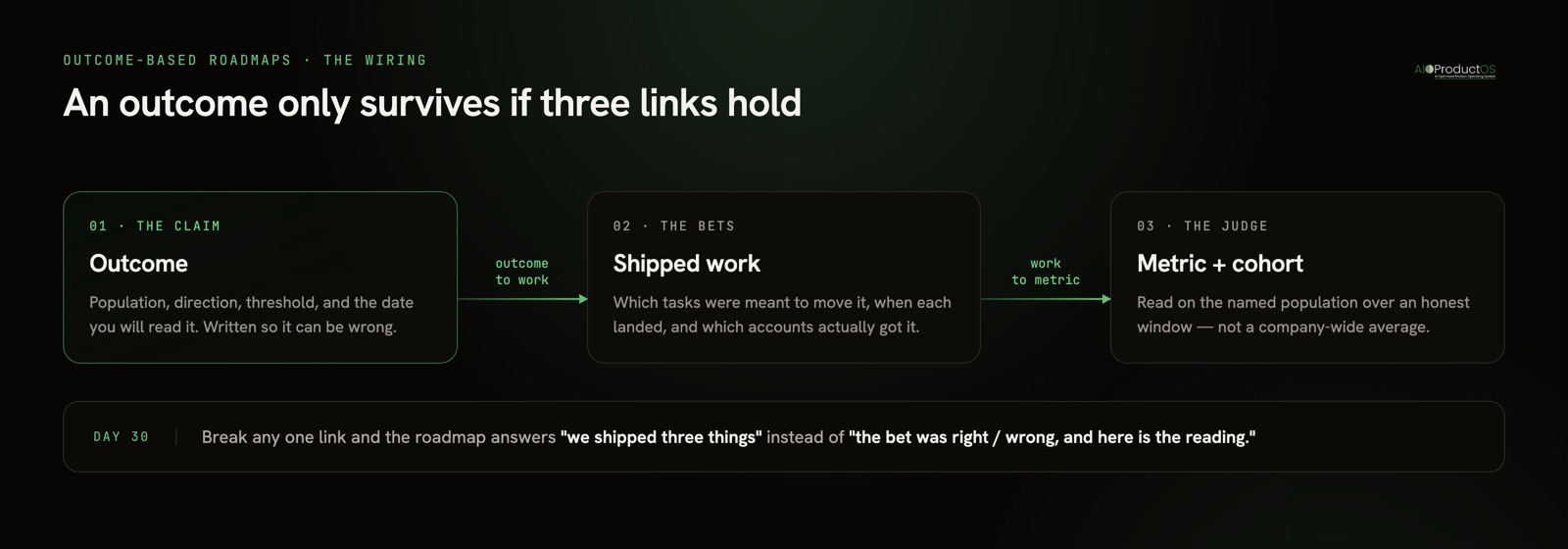
An outcome roadmap fails quietly, and it fails at the join rather than at the drawing. Three links have to survive from the moment the outcome is written to the moment it is read:
Outcome to work. Which specific tasks were meant to move this? If the answer is reconstructed from memory in the review, you will credit whatever shipped nearest the number moving.
Work to exposure. When did each of those land, and which accounts actually got it? An outcome judged over a window that includes six weeks before the feature existed is not being judged at all.
Work to metric. Which cohort does the metric read, and does it match the population named in the outcome? A company-wide activation number cannot answer an outcome scoped to mid-market.
Maintaining those three links by hand is the tax that kills the practice. Context-switching costs an estimated $450 billion a year, with the average employee losing 40% of productive time to it (Gallup) — and reconciling a roadmap, a tracker, and an analytics tool by copy-paste every month is a fair sample of that. It gets done in month one and abandoned by month three, at which point the outcome roadmap has degraded into a feature roadmap with aspirational headers.
The alternative is that the three links are the same record rather than three tools. That is the design AIOProductOS is built around: work is grouped under Goals/OKRs, features rank by request count and the revenue at stake, and every shipped feature ends up carrying a verdict — adoption, MRR adopted, retention lift — on its own task card, with the underlying behaviour captured by first-party product analytics on the same customer record.
The number didn’t move. Now what?
This is the question the outcome roadmap creates and almost nobody writes down the answer to. Work through it in order, because three of the four possibilities are not “the idea was bad.”
Did it reach the population in the outcome? Check adoption before you check the outcome. If barely anyone in the named population used the thing, the hypothesis was never tested — you have a discovery or distribution problem, not a disproved bet.
Was the window honest? Set the window from how often the underlying job occurs, not from when the review is scheduled. A feature tied to a quarterly ritual cannot be graded in three weeks.
Did it move for adopters but not in aggregate? Compare adopters against comparable non-adopters. A real lift inside a small cohort disappears in a company-wide average, and the correct next move is distribution, not a rebuild.
Everything checks out and the number is flat. Then the hypothesis was wrong, which is the outcome roadmap working as designed. Write that verdict next to the row while the context is still fresh, keep the row visible instead of deleting it, and let it change how the next round is ranked. Where revenue was the argument for the bet, feed the result back into the revenue-at-stake ranking so the next estimate is calibrated rather than re-guessed.
The failure mode to avoid is the fifth option teams reach for: quietly redefining the metric after the reading. Naming the counter-signal in advance — the result that would make you stop — is what makes that harder to do.
When a feature or date roadmap is genuinely the right call
Outcome framing is not universally correct, and pretending otherwise gets teams into trouble.
If a signed contract commits you to a go-live, the date is the deliverable and an outcome header does not replace it. The same holds for compliance and regulatory deadlines with a filing window, platform deprecations you do not control — an OS release, an API sunset, a payment mandate — and hardware or partner launches where someone else’s manufacturing slot or marketing calendar sets the clock. In all of these the work is defined by an external party, and dressing it as an outcome adds ceremony without adding a decision.
The other genuine exception is volume. An outcome needs a metric that can be read, and early-stage products often have too few accounts for any number to separate signal from noise. With a handful of customers you learn faster from conversations than from a metric that swings 30% because one workspace went quiet. Write outcomes anyway if it helps you think, but do not pretend the reading is evidence.
Wire it, or it’s a slide
An outcome-based roadmap is not a formatting choice and it is not a maturity badge. It is a claim that specific work will change a specific number for specific people, held together by three links that most stacks break by default. Write outcomes you can be proven wrong about, keep each one attached to the work and the metric, and answer honestly on the day you said you would.
Want the verdict to arrive attached to the work instead of assembled by hand? See how outcome attribution in AIOProductOS puts adoption, the revenue that adopted, and retention lift on the task card of every feature you ship.