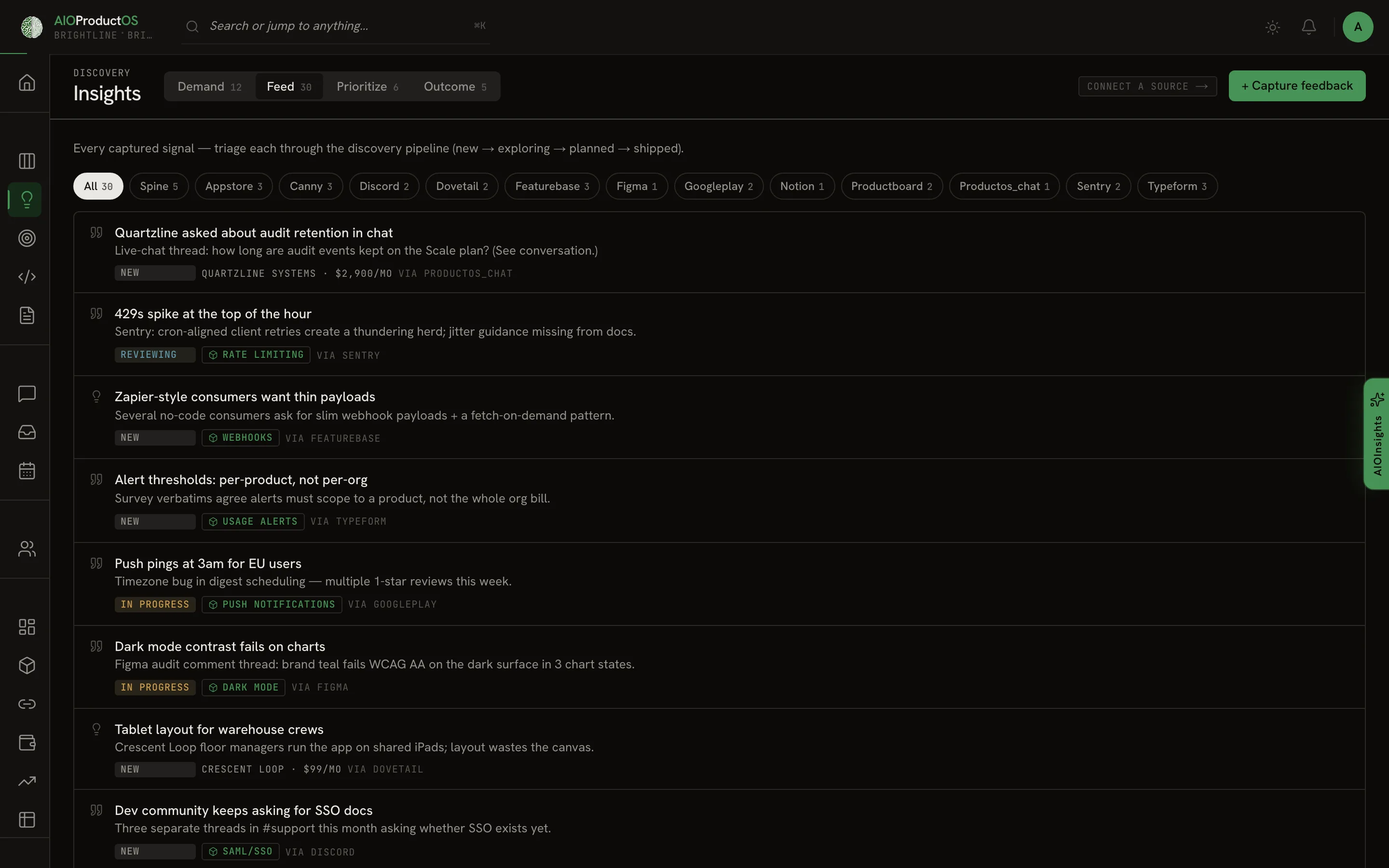
You do not need a data team to know how your product is used. A small team can ship product event tracking in an afternoon — one async script tag, a track call at each moment that matters — with an SDK that gzips to about 3.7 KB. And because events land on a shared spine keyed to the customer, the analytics arrive already joined to revenue and shipped work, not stranded in a silo you reconcile later. You install the SDK in your own product; the join is the part you would otherwise hire for.
How does a small team instrument a product in an afternoon?
By instrumenting the moments that matter, not everything. The usual reason event tracking becomes a quarter-long project is that teams try to build a governed tracking plan, a warehouse, and an ETL pipeline before the first event fires. Skip that. Start with the four or five events that answer your real questions.
Add the script once:
<script async src="https://platform.aioproductos.com/sdk/productos.js"
        data-org="your-org-key"></script>
Then drop a track call at each meaningful moment — signup completed, first key action, a feature used, an upgrade clicked:
// illustrative — one line per event that matters
productos.track("activated", { plan: "team" });
That is the whole loop. No warehouse to provision, no ETL job to schedule, no data model to design up front. The few-kilobyte bundle loads async so it never blocks render, and it runs on EU or US data residency picked at onboarding.
Why is “revenue-joined” the hard part, and how does the SDK skip it?
Because instrumenting events is the easy 20%. The expensive 80% — the part that normally needs a data engineer — is making those events connectable to revenue. In a fragmented stack, events live in one tool and billing lives in another, and answering “which paying accounts used this feature?” means exporting both and matching by email in a spreadsheet. That reconciliation is exactly the join nobody does.
Here the join is not a step you build — it is a property of where events land. The spine keys every event to the same customer and account ID your revenue records use, so the moment an event arrives it already resolves to one record next to that customer’s subscription and shipped work.
| Task | With a data team + warehouse | With a drop-in SDK |
|---|---|---|
| Capture events | Instrument + pipeline | One script + track call |
| Store them | Provision warehouse | Lands on the spine |
| Join to revenue | ETL + modeling | Already keyed |
| Time to first answer | Weeks | An afternoon |
See how the mapping works on the analytics page and the full SDK family on the SDKs page.
What can you actually answer once events are joined?
The questions a small team usually cannot answer without begging for a data ticket:
- Which paying accounts use this feature, and which trials never touched it?
- Did activation move after we changed onboarding — for revenue accounts specifically?
- Which requested feature, once shipped, actually changed usage for the customers who asked?
None of these need a warehouse. They need events and revenue on one record, which is what the spine gives you on arrival. A product-data connector can pull your billing tool onto the same spine, so even your Stripe or Paddle data joins to the events without a pipeline.
When is a data team and warehouse actually warranted?
When your needs outgrow instrumentation and become infrastructure. If you need heavy custom transformations, blending across dozens of sources for BI, financial-grade reconciliation, or a governed tracking plan enforced across many squads, that is real data-engineering work — a data engineer plus a dbt-on-warehouse pipeline earns its keep, and a drop-in SDK will not replace it. At serious scale, warehouse-grade modeling is not overhead; it is the product of the data function.
But most small teams are nowhere near that line. Their problem is not “our model is too complex” — it is “we have no instrumentation and no one to build a pipeline.” For that team, an afternoon with a few-kilobyte SDK beats a hiring plan, and the analytics come pre-joined to revenue. Reach for the warehouse when the transforms get real; not before.
The short version
Product event tracking does not have to wait on a hire or a pipeline. A small team adds one async script, drops a track call at the moments that matter, and is live in an afternoon — with events that land on a spine already joined to revenue and shipped work. The hard part is normally the join, and here the join comes free with where the data lands.
You can see events, revenue, and shipped work on one customer record in the live no-signup demo — no account, no setup.