Does GDPR require your data to be stored in the EU?
No. GDPR does not mandate that personal data physically stay inside the EU. It regulates transfers outside the EEA, which require a lawful mechanism — most commonly the European Commission’s Standard Contractual Clauses. “Stored in the EU” and “GDPR compliant” are two separate claims, and vendors routinely blur them.
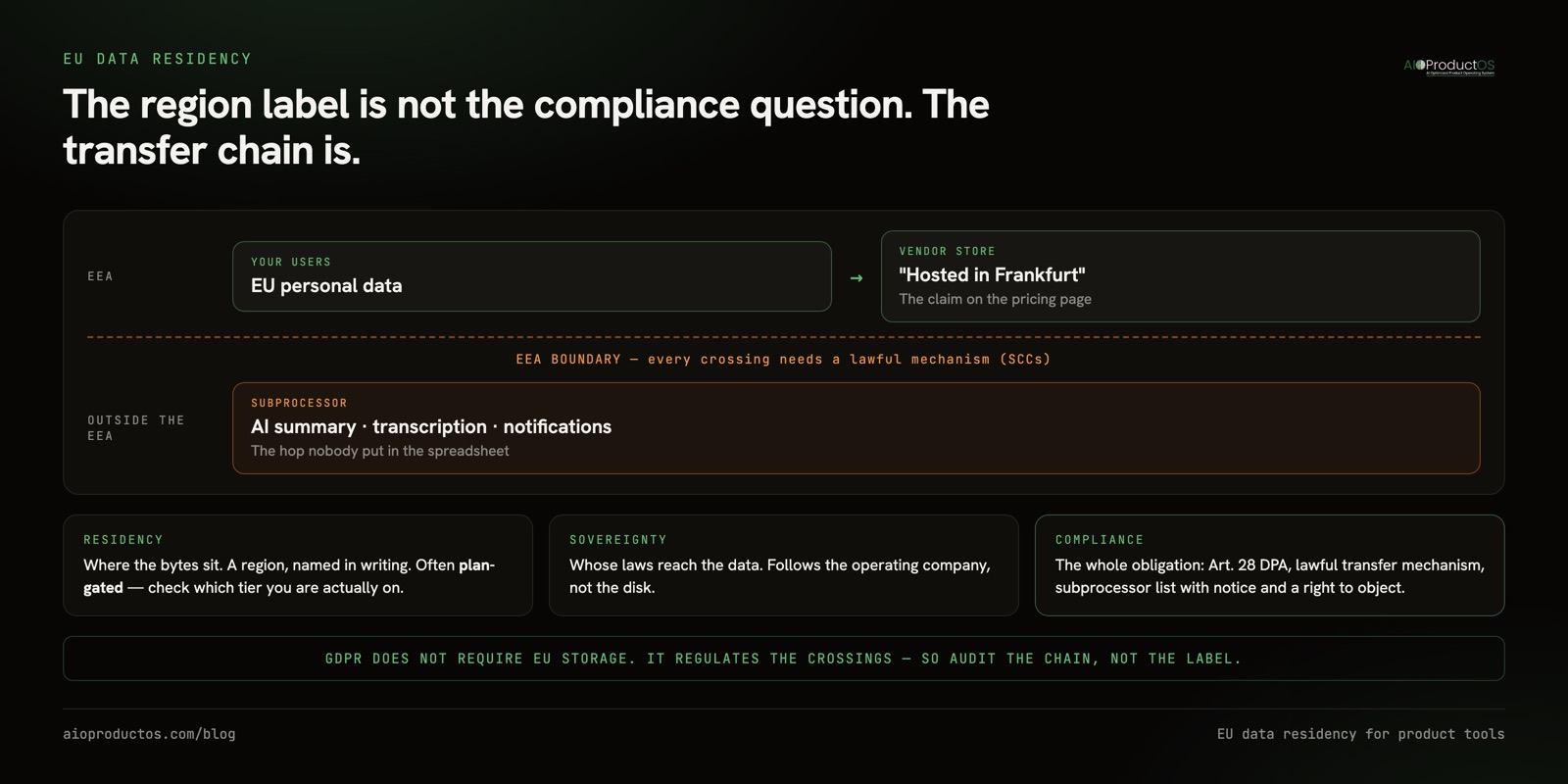
That blur is commercially useful, which is why most of what you find when you search this topic is either a legal explainer that never touches your actual tooling, or a listicle of EU-hosted vendors written by an EU-hosted vendor. Neither one hands you the thing a product team actually needs: a procedure for walking your own stack and finding out where your users’ data really lives.
Residency, sovereignty, and compliance are three different claims
Keep these separate, because vendors will not.
Residency is where the bytes sit at rest and where processing happens. It is a factual question with a factual answer: a region, named in writing.
Sovereignty is about whose legal system can compel access to that data. It depends on the operating company and its corporate structure, not only on the location of the disk. Data resident in Frankfurt, held by a company incorporated elsewhere, is still reachable through that company.
Compliance is the whole obligation set: a lawful basis for processing, a data processing agreement under Article 28, a valid transfer mechanism when data leaves the EEA, and honest handling of subject access and deletion requests. Residency is one input into that, not a substitute for it.
A vendor that answers a residency question with “we’re GDPR compliant” has changed the subject. Ask again. So you have a shape to hold other answers against, here is ours: EU or US residency picked at signup and enforced at ingest, on every plan.
Audit your product stack before you audit your vendors
Here is the part nobody hands you. Before you can assess vendors, you need an accurate list of which tools in your product stack hold EU personal data — and that list is almost always longer than the one in your vendor spreadsheet. The average company runs 101 SaaS apps and wastes around $21M a year on licenses nobody uses (Okta, Zylo). The unused ones still hold data.
Start with the tools that touch end users rather than employees. Product analytics, session replay, feedback and survey tools, the support inbox, and whatever CRM or billing system carries customer contacts. Those five categories are where end-user personal data concentrates, and they are the ones product teams buy without a procurement review.
| Stack layer | Personal data it typically holds | Where it lives — what to establish | What the contract must say |
|---|---|---|---|
| Product analytics | User IDs, emails, IPs, device and behavioural event streams | Storage region for the event store; is EU residency a plan tier or a paid add-on? | DPA with SCCs; retention window for raw events |
| Session replay | Recorded screens, form inputs, potentially special-category data caught by accident | Region of the replay store, which is often separate from the analytics region | DPA plus documented input masking; who can view replays |
| Customer feedback / surveys | Names, emails, free-text that users write about themselves | Region of the response store and of any AI enrichment step | DPA; whether responses are processed by a model vendor, and under whose terms |
| Support inbox | Full conversation history, attachments, whatever a user pastes into a ticket | Region of the ticket store and of every notification, transcription, or AI-summary subprocessor | Published subprocessor list with advance notice and a right to object |
| CRM / billing | Contacts, company data, payment metadata | Region of the CRM records; the payment processor is usually a separate entity | DPA; the processor’s own certifications; transfer mechanism for each hop |
Two things fall out of filling this in honestly.
The first is that residency is frequently plan-gated. Many popular SaaS tools default to US hosting and offer EU residency only on higher tiers or as a paid add-on, which means your EU residency posture is quietly a function of your billing plan. If nobody has checked which plan you are actually on, you do not know your posture — you know your intention.
The second is that the subprocessor list is where the answer usually is. A tool can host in Frankfurt and still route support notifications, transcription, or AI summarisation through a US subprocessor. That hop is a transfer, and it needs the same lawful mechanism as any other. Ask for the list, ask how much notice you get before it changes, and ask whether you can object. If a vendor cannot produce it, that is the finding — not a paperwork gap.
Read the DPA rather than the trust page. Trust pages assert; the DPA commits. Ours is a self-serve Article 28 addendum at the self-serve DPA: it incorporates the Standard Contractual Clauses for transfers outside the EEA, points at a live subprocessor list, and commits to publishing any new subprocessor at least 30 days in advance with a right to object during that window. Hold every vendor to that shape, including us.
When EU residency is not the thing to optimize for
This is the section the EU-hosted vendor listicles will never write.
A US-hosted vendor with a signed DPA, clean Standard Contractual Clauses, a short published subprocessor list, and real advance notice of changes can be a better position than an EU-hosted vendor that quietly forwards your support data to a US subprocessor with no notice period. Residency is a visible property. The transfer chain is the load-bearing one, and it is the one that gets audited.
Switching costs are real, too. Ripping out a working analytics or support stack to satisfy a residency checkbox you are not contractually required to satisfy buys you a migration, a retraining cycle, and a new set of exit risks — and consolidation carries its own dependency trade-off, which we walked through in vendor lock-in in product tools. If your DPA obligations are met through SCCs and your data protection impact assessment holds, “move everything to an EU vendor” is a preference, not a remediation. Treat it as one, and spend the effort on the tools where the transfer chain is genuinely undocumented.
Residency also does nothing about a separate question that matters more to most product teams: whether a vendor’s AI features retain or train on your customer data. That is settled in the DPA and the model vendor’s terms, not by the location of a database. We covered how to verify it in is your PM tool training AI on your data?. A tool can be perfectly EU-resident and still be the wrong place to put your customer interviews.
Finally, be honest about scope creep. Every connector you add extends the chain. Our own connector catalogue is 100+ integrations, and each one you enable is another party in the diagram — which is exactly why the subprocessor question belongs in the audit rather than at the end of it.
Where AIOProductOS stands
Stated plainly, and only what we can back.
You pick EU or US residency at signup, enforced at ingest, not offered as a best-effort preference, and it is included on every plan from the first tier, where most tools reserve it for Enterprise. Enterprise adds contractual region pinning and a DPA or BAA. Roles are enforced in the database through row-level security rather than hidden in the UI, each organisation gets BYOK envelope encryption with its own AES-256-GCM key, and we do not train AI on customer data. A full-org GDPR export is available on every tier, so leaving is a button rather than a negotiation.
Two honest limits. AIOProductOS is operated by AIOProductOS Inc., a Delaware C-Corporation, so EU-resident data still sits with a US-incorporated operator — which is precisely why the SCCs and the subprocessor commitments in our DPA matter, and why we publish them instead of leaning on the region label. And our compliance posture is readiness, not certification: 159 controls mapped across 18 frameworks including SOC 2, ISO 27001, GDPR and HIPAA, self-assessed until an external audit completes. If a certificate is a hard procurement gate for you today, that is a fair reason to wait.
Run the audit above against your current stack this week. Most teams find at least one tool whose storage region nobody has ever confirmed in writing — and finding it now is considerably cheaper than finding it during a security review. When you get to us, the residency, isolation, and export specifics are all laid out on the trust page.