The research-vendor guides on page one all end in the same place. They list the methods, agree that surveys give breadth and interviews give depth, mention that DIY is possible, and then explain that at some point you will want a real platform or a real firm. That is not dishonest, exactly. It is just that none of them are structurally able to tell you which parts of their own engagement you could replace with a Tuesday afternoon and a customer list you already have.
So here is the decomposition, from someone who is not selling research. A firm’s invoice covers five separable jobs. Three of them a three-person product team can take over this month. Two of them are genuinely worth money, and knowing which two is the whole decision.
Can a small product team do customer research without a research firm?
Yes — most of it. A research firm sells five separable services: recruiting, incentives and scheduling, moderation, synthesis, and neutral third-party distance. A team with paying customers already owns the recruiting list and can run the middle three this month. Pay only for access you genuinely lack, and for neutrality when the study is about you.
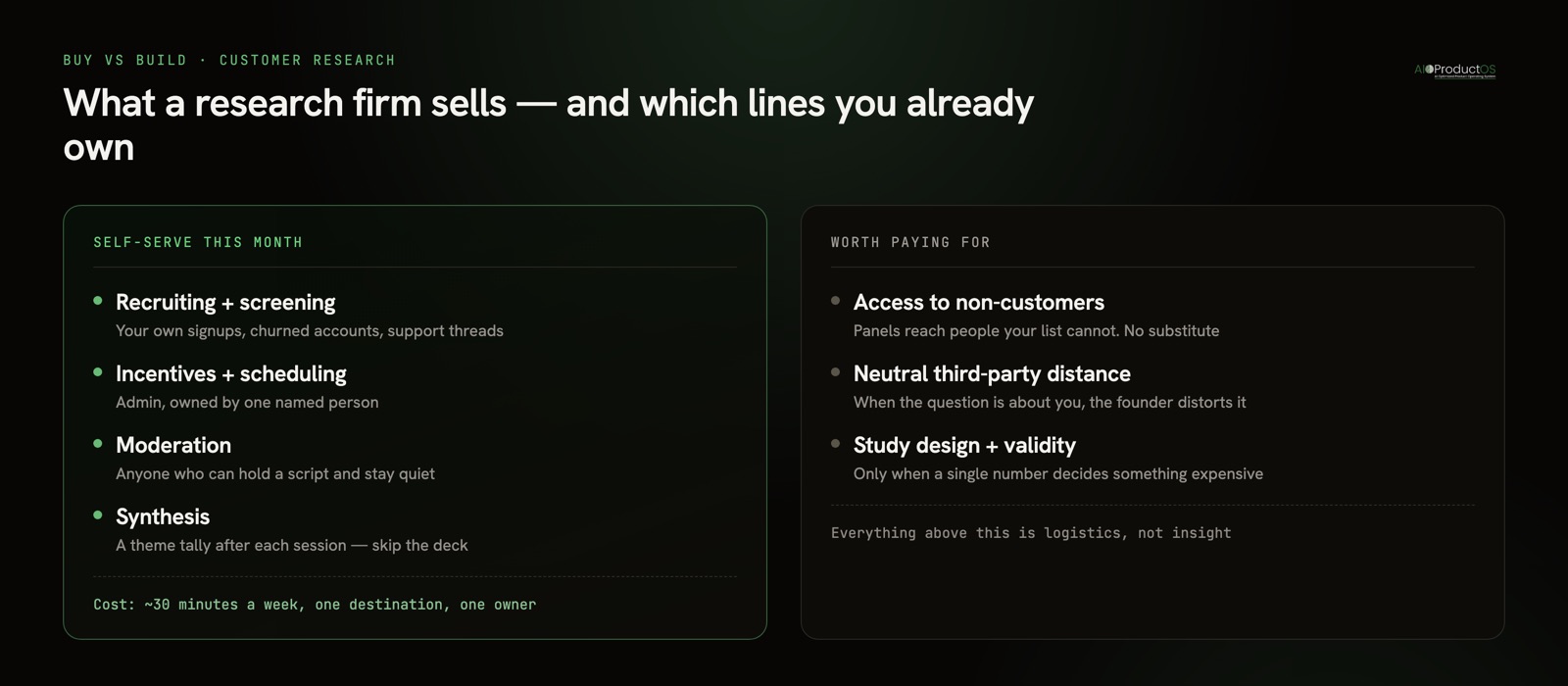
The reason this decomposition matters more than a methods comparison: buying research is usually framed as one yes-or-no purchase, so a team that cannot afford the whole engagement concludes it cannot afford any of it, and does nothing. The line items price very differently. Recruiting is expensive when you need strangers and nearly free when you need your own customers. Neutrality is nearly free when the question is about someone else’s product and expensive when it is about yours.
What a research firm is actually selling, line by line
The pricing tracks how hard your population is to reach, which is why you rarely get a number before a scoping call. Read the invoice as labour plus access, not as insight, and each row becomes a separate buy-or-build call.
| What the firm sells | Why it costs what it costs | Your substitute | Verdict |
|---|---|---|---|
| Recruiting and screening | Sourcing strangers who match a screener, then filtering out the professional respondents | Your own list: last month’s new signups, churned accounts, and anyone who opened a support thread about the thing you’re studying | Self-serve |
| Incentives and scheduling | Gift cards, no-show buffers, and the calendar churn nobody wants to own | The same admin, owned by one named person. Your own customers frequently agree without an incentive, because you are the people who build the thing they use | Self-serve |
| Moderation | A trained interviewer who does not defend the product | Whoever on your team can hold a script and stay quiet. The scripts and the awkward moments are covered in customer interviews without the awkwardness | Self-serve, with one caveat below |
| Synthesis and reporting | Analyst hours coding transcripts into themes, plus a deck for stakeholders | A theme tally after each session, which also tells you when to stop — see how many customer interviews are enough | Self-serve; skip the deck |
| Study design and statistical validity | Sampling and instrument design so a number means what you think it means | Nothing free replaces this when a single number is going to decide something expensive | Pay, but only in that narrow case |
| Neutral third-party distance | Respondents answer a stranger differently than they answer the founder | Partially: a colleague who did not build the feature can moderate | Pay when the question is about you |
| Access to people you cannot reach | Panels, screeners, and reach into non-customers, competitors’ users, and regulated populations | You do not own this. There is no substitute | Pay |
Two rows carry real money for a small team: access and neutrality. Everything above them is logistics you are already doing badly for free. The statistical-design row is the honest third case, and it is narrow enough to belong in the counter-case section rather than the default plan.
One caveat on running moderation yourself, since it is the row most likely to go wrong quietly: a moderator who built the feature will hear agreement that is not there. That is a real cost, and it is not the same as needing a firm. It is usually solved by handing the script to a teammate.
The feedback already arriving that nobody routes
Here is the failure mode that no research vendor will name, because their product does not fix it: for most small product teams, collection is not the bottleneck. Feedback is already arriving, in volume, through channels you own and pay nothing extra for.
Count them. Support conversations, where the specific words are better than anything a screener would produce. Sales and demo calls, where prospects describe the workaround they are currently living with. Cancellation notes, which are the highest-signal and least-read text your company owns. Public reviews and community threads. In-app messages and micro-survey replies. That is five sources, arriving continuously, from people who have already selected themselves as caring enough to type.
The reason it feels like you have no research is that those five land in five destinations with no shared owner: a helpdesk, a CRM, a billing tool’s cancellation field, someone’s browser bookmarks, and a channel that scrolls. Nothing accumulates, so nobody can answer “what have we heard about onboarding this quarter” without an hour of archaeology — and under deadline pressure, nobody spends the hour. That retrieval tax is the real expense. Context-switching across tools costs an estimated $450 billion a year, with the average employee losing 40% of productive time to it (Gallup). A team in that state will conclude it needs to buy research, when what it needs is to stop losing the research it is already given.
Fix the routing before you buy anything. If you are choosing between a firm and doing nothing, the third option — harvesting what already arrives — is cheaper than both and usually answers the question.
The routine that survives a real week
DIY research does not fail during the study. It fails in week three, when the person who volunteered gets pulled onto a release. Four constraints keep it alive.
One owner, named, for a month at a time. Not “the product team.” A rotating single owner is more robust than a committed group, because a group has no one to notice when the routine stops.
One destination, chosen before you start. Every finding, from every one of the five channels, goes to the same place. A shared doc counts, as long as it is genuinely one place. The moment there are two, the routine is already decaying.
Thirty minutes a week, not a quarterly deep-dive. The weekly slot is for routing, not analysis: move last week’s support threads, cancellation notes, and call notes into the destination. Deep-dives get cancelled; a half-hour recurring slot mostly survives.
Two scheduled conversations a month, sourced from a standing rule. Fixing the source is what removes the decision fatigue that kills DIY rounds. A rule like “one churned account and one customer who opened a support thread about the area we’re working on” produces a booking list without anyone having to think.
Then test the routine with retrieval, not volume. Ask someone who was not in the sessions to answer “what did customers say about onboarding this quarter” and time them. Under two minutes means the routine works. Ten minutes of hunting means you have a filing system, not a research practice, and the next round will quietly not happen. What you do with the findings once they are findable — prioritizing them and proving the change worked — is a separate discipline, covered in turning customer feedback into product changes.
When paying a research firm is genuinely the right call
Four cases where the DIY answer is wrong, and one of them is common.
You need people who are not your customers. This is the common one. Anything about why prospects chose a competitor, what non-users believe about the category, or how a segment you do not yet serve works cannot be answered from your own list. Your customers are, by definition, the people your product already suits. No amount of internal discipline substitutes for panel access here.
Your presence poisons the answer. When the question is about your pricing, your brand, or whether someone would leave you, respondents manage the relationship instead of answering. A founder in the room makes it worse, not better, because people are kind. A neutral moderator and a blinded study are worth paying for when the answer being wrong is expensive.
Regulated populations or legal exposure. Health, financial, or child-related research carries consent, data-handling, and duty-of-care requirements that are not a checklist you improvise. If the research touches a regulated domain, the firm is buying you compliance as much as insight.
A single number is going to decide something expensive. A pricing change you will bet the year on needs sampling and instrument design, because a badly framed willingness-to-pay question returns a confident number that is wrong. This is where the statistical-design row earns its price. Note the shape of the exception: it applies when one number decides, not when you want a number. If the choice of instrument itself is the open question, surveys vs interviews is the cheaper first read.
Outside those four, a firm is buying you logistics and a deck.
Where this leaves you
The buy-versus-build call on customer research is not one decision, it is seven, and five of them go your way if you have customers and thirty minutes a week. The one that decides whether any of it compounds is the destination: a single place where a support thread, a cancellation note, a call quote, and a survey reply about the same problem sit next to the account that said it.
That is the design Insights starts from in AIOProductOS — one feedback feed across reviews, requests, surveys, designs, and support, with each item linked to the feature it informs and the account it came from, plus NPS and CSAT micro-surveys with NPS weighted by revenue. Over 100 live connectors pull the channels you already run into that record, so the five destinations collapse into one without anyone changing where they work. The point is not the software. The point is that the retrieval test passes next quarter.
Start with the routing, not the purchase. Our guide to the best feedback tools compares the honest options for giving your existing feedback one destination — including the ones that cost nothing.